 how-to
How to Build Math Confidence Fast in High School
Last Updated: October 29, 2026
Quick Summary
You build math confidence fast by running 15-minute exposure blocks four days a week: a quick warm-up win, one hard problem with no timer, then a mistake log entry. Short repeated exposure teaches your nervous system that hard problems are survivable, which restores working memory and reduces anxiety.
- Diagnose first: if you can solve a problem with notes and no timer, the issue is pressure, not knowledge.
- During a confidence crash, take four slow breaths, in for four counts and out for six.
- Rebuild gaps in order: fix missing skills first, practice shaky skills with mixed sets, leave solid skills alone.
- Review notes within 24 hours; a five-minute pass locks in more than an hour of re-reading later.
- Track problems solved without notes, recall time, and hard problems attempted instead of relying on grades.
Table of Contents
- Why Math Confidence Cracks, and How to Rebuild It Fast
- How to Overcome Math Anxiety Without Avoiding the Work
- How to Catch Up in Math When the Basics Have Gaps
- A Math Study Plan for High School Students That Fits Real Schedules
- How to Get Better Grades in Math With Weekly Habits
- Building Your Eight-Week Confidence Plan With a Tutor
- Frequently Asked Questions
Why Math Confidence Cracks, and How to Rebuild It Fast
Math confidence is the belief that you can work through a problem, get stuck, and still find your way out. It is not the same as being fast or always right. Capable students often freeze because one bad unit convinces them they are "bad at math."
That story is fixable, and faster than most people expect.
Spot the Real Obstacle Before You Study
Most students assume the problem is the material. Usually it is one of four things:
- A skill gap. Fractions or algebra rules never fully landed.
- Test anxiety. The knowledge is there, but panic shuts it down.
- Slow recall. The student knows the method but needs too long to retrieve it.
- A confidence story. One failure became a fixed identity.
Diagnose before you drill. Ask: "Can you do this problem with notes and no timer?" If yes, the issue is pressure, not knowledge. If no, it is a gap. Those need different fixes.
How to Overcome Math Anxiety Without Avoiding the Work
Avoidance is the trap. Students skip the hard problems, feel relief, and fall further behind. The fix is exposure in small, safe doses, but "small doses" needs a schedule, or it never happens.
Use a 15-minute exposure block, four days a week. The structure matters more than the length:
- Minute 0-2: Warm-up win. Solve one problem you already know cold. This primes recall and lowers the threat response before the hard work starts.
- Minute 2-12: One hard problem, no timer. Choose a problem just above your current comfort level, one you can attempt but not necessarily finish. Struggle is the point; the goal is to stay in the problem for ten minutes without escaping.
- Minute 12-15: Mistake log entry. Write the error, the correct step, and the rule behind it. This converts the anxiety episode into a study artifact you can review later.
Why this works: anxiety narrows attention and shortens working memory, so students literally hold fewer steps in mind under pressure. Short, repeated exposure teaches the nervous system that the hard problem is survivable, which restores access to working memory.
Language shifts still matter, but only when they are specific. Replace "I can't do this" with "I can't do this yet," and replace "I'm bad at math" with "I'm missing a specific skill", then name the skill. Vague reassurance does not move behavior; naming the gap does.
The American Psychological Association's guidance on stress and learning notes that reframing stress as a normal response can improve performance.
What to Do During a Confidence Crash
A confidence crash is the moment a student shuts down mid-problem or mid-exam. Have a plan ready before it happens:
- Pause and breathe. Four slow breaths, in for four counts, out for six, resets focus faster than trying to "calm down."
- Drop to an easier problem. Rebuild momentum with one quick win, then return.
- Write what you know. Even partial steps earn credit and restart thinking; blank space feeds panic.
- Skip and return. Stuck problems grow in your head; fresh eyes help.
- Use a 60-second reset script. Say: "This is a normal stress response. I know the first step. I will write it down." Then write it.
The goal is to stay in the work, not to feel calm instantly. A crash handled in 60 seconds costs one problem; a crash handled by avoidance costs a unit.
How to Catch Up in Math When the Basics Have Gaps
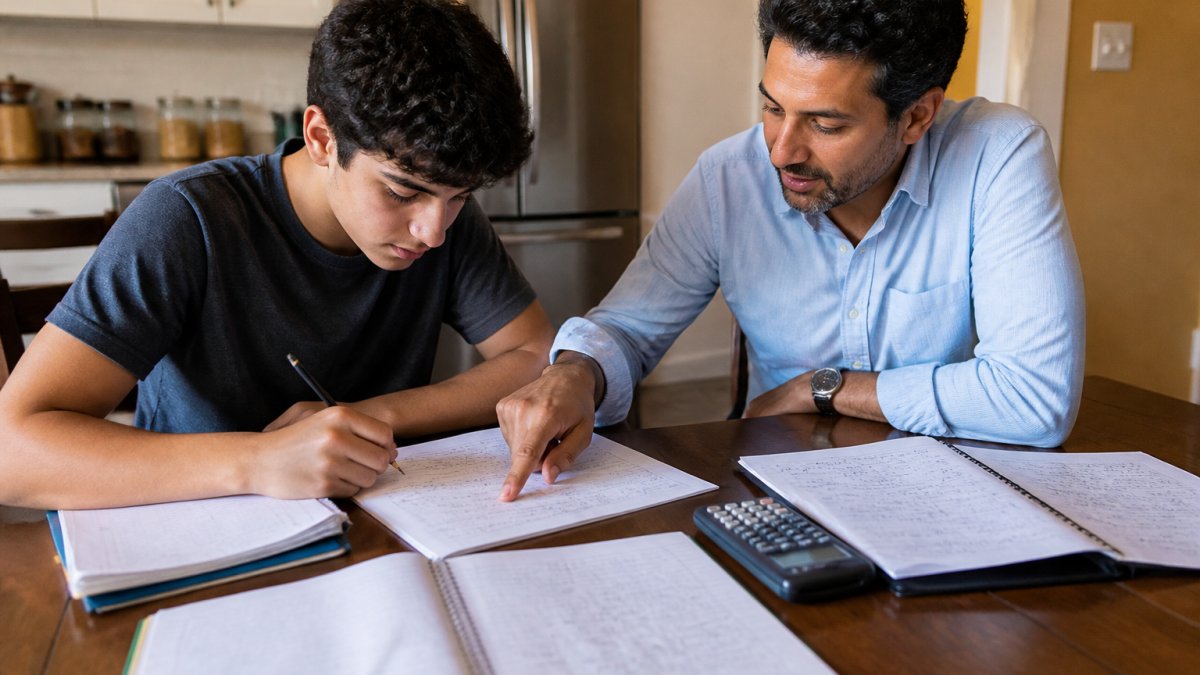
Catching up means going back before going forward. That feels wrong to students who want to keep pace with their class, but it is the only route that holds.
Start with a short diagnostic. List the last three units where grades dropped. For each, test one core skill: solving linear equations, simplifying fractions, using the quadratic formula. Mark each as solid, shaky, or missing.
Then rebuild in order:
Apply Now — Free Consultation →
- Fix "missing" skills first, one at a time.
- Practice "shaky" skills with mixed problem sets.
- Leave "solid" skills alone except for quick review.
A common mistake is jumping to current homework while the foundation is still cracked. Ten focused minutes on a missing skill saves hours of confused homework later.
A Math Study Plan for High School Students That Fits Real Schedules
A workable math study plan for high school students runs on short, regular sessions, not marathon cramming. Consistency beats intensity here.
Here is a weekly structure we recommend:
| Day | Focus | Time |
|---|---|---|
| Monday | New concept from class | 25 minutes |
| Tuesday | Practice problems on that concept | 25 minutes |
| Wednesday | Mistake log review | 15 minutes |
| Thursday | Mixed review from earlier units | 25 minutes |
| Saturday | One hard problem, no timer | 30 minutes |
Keep sessions short enough that you will actually do them. A plan you follow at 70% beats a perfect plan you abandon.
Measure Progress Beyond Test Scores
Grades lag behind real learning. Track these instead:
- Problems solved without notes
- Time to recall a formula or method
- Number of hard problems attempted, not just solved
- Confidence rating from 1 to 10 before each session
When the recall time drops and the hard-problem count rises, grades follow. Watching those numbers gives students proof of progress on bad weeks.
The National Council of Teachers of Mathematics stresses that productive struggle, not just correct answers, builds real understanding.
How to Get Better Grades in Math With Weekly Habits
Better grades come from habits, not heroics. Four weekly habits do most of the work:
- Review notes within 24 hours. A five-minute pass locks in more than an hour of re-reading later.
- Do one problem from memory. Close the book and reconstruct a solution.
- Ask one specific question per week. "I lose the sign on step three" gets real help; "I don't get it" does not.
- Practice under mild time pressure. Ten minutes on a timer builds exam stamina.
Building Your Eight-Week Confidence Plan With a Tutor
A structured plan beats willpower. Here is how we would map eight weeks:
- Weeks 1-2: Diagnostic and gap repair. Identify missing skills, rebuild the top two.
- Weeks 3-4: Daily practice habit. Short sessions, mistake log, weekly review.
- Weeks 5-6: Hard problems and test-style practice under light timing.
- Weeks 7-8: Full review, confidence check, and a plan for the next term.
One-on-one support can help a tutor identify specific gaps, adjust a plan over time, and keep sessions focused. Discover 360 Tutoring builds each plan from a targeted diagnostic, assigns a dedicated tutor, and sends parents regular progress updates. Sessions are available online or in person, with flexible scheduling options.
The U.S. Department of Education's guidance on evidence-based tutoring supports intensive, individualized tutoring as one of the strongest interventions for students who have fallen behind.
Frequently Asked Questions
How long does it take to improve math confidence?
Most students notice a shift in a few weeks when they practice consistently and work on the right material. Confidence grows from small successes, so short daily sessions beat one long weekly cram. A structured plan with a diagnostic check at the start helps you target gaps instead of reviewing what you already know.
How can I overcome math anxiety before a test?
Start by naming the feeling instead of fighting it, then shrink the task: one problem, one step. Practice under timed conditions so the exam setting feels familiar, and review mistakes calmly rather than judging them. Positive self-talk matters too. Replace "I'm bad at math" with "I haven't learned this step yet." If anxiety shuts you down in sessions or exams, a tutor who uses supportive feedback and step-by-step solutions can help you build tolerance gradually.
Can a tutor help build confidence in math?
Yes, when the tutoring targets the actual gap rather than repeating the same worksheets. A good tutor runs a diagnostic assessment, builds a custom plan, and gives supportive feedback that treats mistakes as learning opportunities. One-on-one instruction also lets a student ask questions without an audience, which lowers anxiety. Look for regular progress updates and a tutor who adapts the plan as skills improve.
What should I do when I get stuck on a math problem?
Stop and write down what you know and what the question is asking. Try a smaller version of the problem, check a worked example, then attempt the next step only. If you are still stuck after a few minutes, mark it and move on so momentum does not stall. Bring a list of stuck problems to your next study session or tutoring appointment, where a tutor can walk through the step-by-step solution and the reasoning behind it.
Math confidence does not arrive on its own, and waiting for a good test score to feel capable is a losing bet. Start with a diagnostic, fix the real gap, and practice in short, steady blocks. If you want the plan built and adjusted for your student, Discover 360 Tutoring offers a free consultation, personalized one-on-one instruction, and a custom learning plan that targets foundational gaps. Get started with Discover 360 Tutoring and watch confidence and grades move together.